Some products cannot fully communicate their main advantage simply by placing them on a table and photographing them. When a device combines several functions, a different question arises:
How can I explain the product’s functionality without making the image look like an ordinary product photograph?
This visual for the Bernessa iron was created around exactly that question.
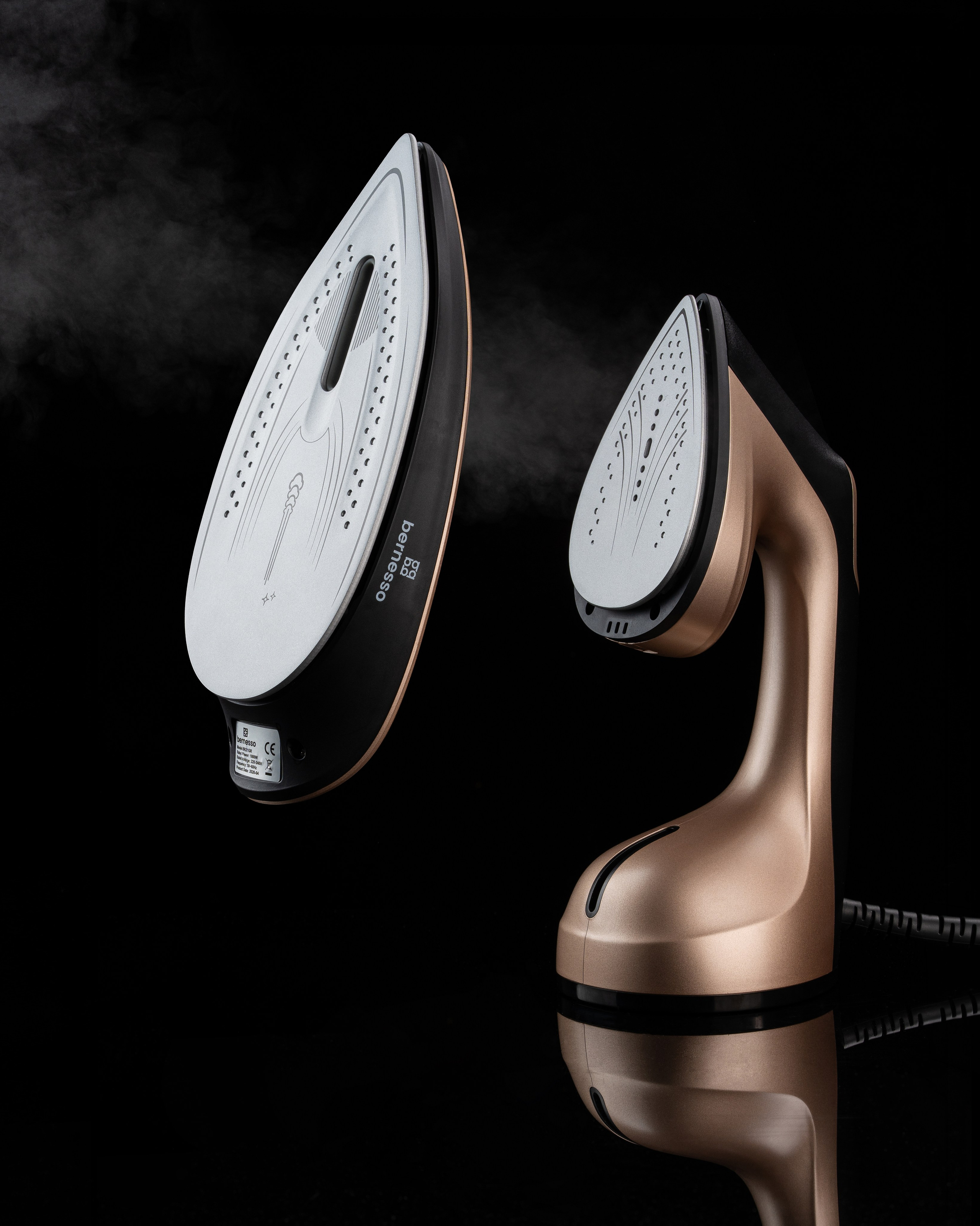
The product can be used both as a garment steamer and, with its detachable sole, as a conventional iron. Instead of showing these two functions in two separate photographs, I wanted to communicate them within a single surrealistic frame.
The result is a futuristic and slightly surreal composition in which one part of the product appears to float separately from the main body, creating a visual connection between its two functions.
1. Concept — Showing Two Functions in a Single Frame
The main idea behind this photograph was to turn two different ways of using the product into one visual story.
I photographed the main device in its complete form on the right side. On the left, I suspended the detachable sole in the air, creating a visual reference to the product’s second function.
The goal was not simply to create the effect of a “floating product.”
The idea was:
One device → two ways of using it → one visual story.
The surrealistic approach makes the functional information more interesting to communicate. At first, the viewer notices the unusual composition. Then, by observing the individual elements, they begin to understand the structure and functionality of the product.
For me, this reflects an important principle in product photography:
Creativity is not only about making an image visually beautiful; it can also be used to communicate information about the product.
2. Composition — The Floating Element Is Not Random
One of the most noticeable elements in the frame is the detachable iron sole suspended on the left.
At first glance, it appears to have separated from the main product and is floating in space. In reality, its position within the frame is an essential part of the composition.
I placed the main product in the lower-right area, giving it strong visual weight. The detached component on the left balances that weight.
This creates two main visual masses:
on the right — the main product,
on the left — the component that explains its functionality.
The negative space between these two elements gives the image room to breathe and strengthens the surrealistic feeling.
If the two parts had been positioned too close to each other, the image could have simply looked like a conventional photograph of a product consisting of two parts. The space between them makes the idea of separation much clearer.
3. Visual Direction — Where Does the Eye Start?
The main hero of the composition is the complete product on the right.
Its size, position and reflection beneath it create the first visual stopping point.
From there, the viewer’s eye moves upward and toward the left, reaching the floating iron sole.
The relationship between these two objects creates a question in the viewer’s mind:
“How are these two elements connected?”
The composition therefore does not simply say:
“There are two objects here.”
Instead, it creates the question:
“How are these two objects connected?”
For me, this is one of the interesting aspects of strong commercial photography — the image should not only show the product, but should also encourage the viewer to spend a few more seconds exploring it.
4. Lighting — Shaping the Product Against a Dark Background
The black background was not an accidental choice.
I used it to make the product’s colors, shape and especially its metallic surfaces stand out more strongly.
The rose-gold / bronze metallic surface of the Bernessa device separates beautifully from the black background.
The main goal of the lighting was not to illuminate the product evenly from every direction, but to model its form through light and shadow.
This is especially important with metallic products. Direct lighting can easily create uncontrolled highlights and unwanted reflections.
Therefore, I positioned and controlled the light carefully across the surfaces to:
- emphasize the metallic edges;
- maintain the three-dimensional shape of the product;
- reveal the texture of the bronze/rose-gold surface;
- prevent the black parts from completely disappearing into the background.
The result is a product that separates clearly from the dark background while maintaining a dramatic atmosphere.
5. The White Iron Sole — Light and Contrast
The light-colored iron sole on the left creates additional contrast within the composition.
Unlike the darker and metallic main body, its bright surface receives and reflects light more broadly.
This element creates both color contrast and form contrast within the frame.
At the same time, the small holes and technical details on its surface reinforce the functional character of the product.
Therefore, this component is not simply a decorative element — it also visually communicates the technical side of the product.
6. Steam — Turning Function into Atmosphere
The steam in the photograph is not simply an atmospheric effect.
It is directly connected to the product’s functionality.
Without the steam, the garment-steaming function would have to be understood mainly from the product’s shape.
The steam provides a much faster visual message:
This device works with steam on garments.
At the same time, the soft steam visible against the black background adds depth to the image and makes the technological appearance of the product more dramatic.
Here, a functional element becomes an aesthetic element at the same time.
7. Reflection — Connecting the Product to the Scene
The reflection visible beneath the main product is another important part of the composition.
With a surrealistic approach, I could have shown the product completely floating in space. Instead, I used the reflection beneath it to visually connect the main product to the surface.
This creates two results:
First: it makes the product feel physically present and believable.
Second: it adds depth and a premium advertising aesthetic to the frame.
The reflection also creates a secondary visual form beneath the product, increasing its visual weight within the composition.
8. Color Harmony — Black, White and Rose-Gold
I kept the color palette of the photograph deliberately limited.
The main colors are:
- Black
- White
- Rose-gold / Bronze
This combination supports both the technological and premium character of the product.
Black creates drama.
The white iron sole emphasizes the technical and functional aspect.
The rose-gold surface gives the product a more premium and refined appearance.
If there were many additional colors in the background, the product’s own color harmony could become weaker. By keeping the palette minimal, I allow the viewer’s attention to return to the product itself.
9. Minimalism and Negative Space
I intentionally left a significant amount of black negative space around the products.
At first glance, this space might appear to be “unused.” In product photography, however, negative space is an important compositional tool.
The empty space:
- gives the product room to breathe;
- makes its shape easier to read;
- strengthens the surrealistic feeling;
- prevents attention from being distracted away from the main elements.
This type of composition can also work well for advertising and banner design, where additional space can later be used for text.
10. Why Does Surrealism Work Here?
In a conventional product photograph, the iron would simply stand on a surface and we would see it as it exists in reality.
In this photograph, I changed the rules of the physical world.
Part of the product is floating in the air.
This immediately attracts the viewer’s attention.
But the surrealism is not being used simply as a visual effect. It transforms the product’s functional advantage into a visual metaphor.
Separating the components visually communicates the product’s multifunctional design.
In other words, surrealism becomes part of the advertising language.
11. The Main Visual Message
If I had to express the entire image in one sentence, it would be:
“One device, different possibilities — technology and functionality in a single product.”
For me, this is where good product photography begins.
A product photograph should not only show what the product looks like. It should also visually communicate what it does, how it can be used, and what feeling it should create.
12. Visual Anatomy — My Main Takeaway
This shoot reminded me once again that in creative product photography, the idea can come before the lighting and even before the camera.
First, I need to identify the product’s key feature:
What do I want to show?
Then comes the next question:
How can I show it differently from a conventional product photograph?
For this photograph, the answer was surrealistic composition.
The floating product component, black background, controlled metallic lighting, steam and reflection do not simply create an aesthetically pleasing image. Together, they form a visual system that explains the functionality of the product.
The goal of creative product photography is not simply to create a beautiful photograph. It is to communicate an idea about the product within a single frame.
Blog

Mesotherapy Products Photography
The Aesthetics of Power: Secrets to Professional Athlete Portrait Photography

Christmas & Winter-Themed Product Photography
Visual Anatomy — #7: Rusel Caviar (Premium Caviar Product Photography)


Art Reproduction Photography

The Anatomy of the Visual — #6: Jungar Hamster and Pumpkins — A Living Still Life



Disposable Food Packaging Photography

Eyewear Photography
Glass Product Photography